May 3rd, 2007 · Comments Off on Roebling Oil Field Construction Update
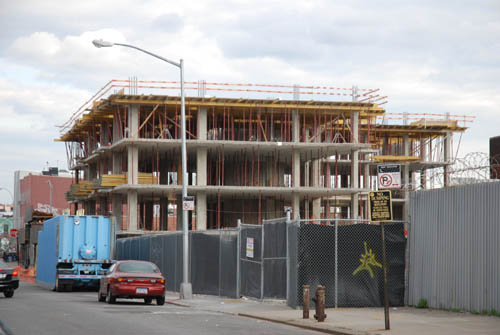
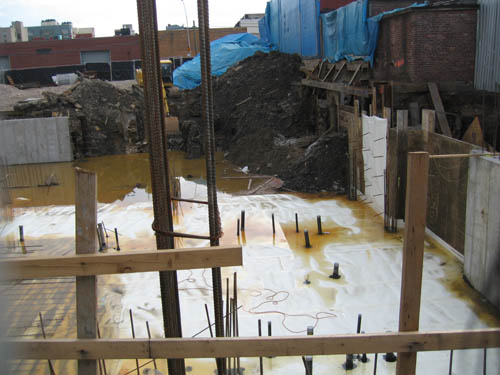
The time is drawing closer for the oily past at the Roebling Oil Field site to be out of sight, if not entirely out of mind. The western end of the site is now under concrete. Soon, all that will be left to remind us are those little wells on N. 11th Street and on Roebling Street. That, and the hundreds of pictures we have of the black ooze and slime that we shot from October through April.
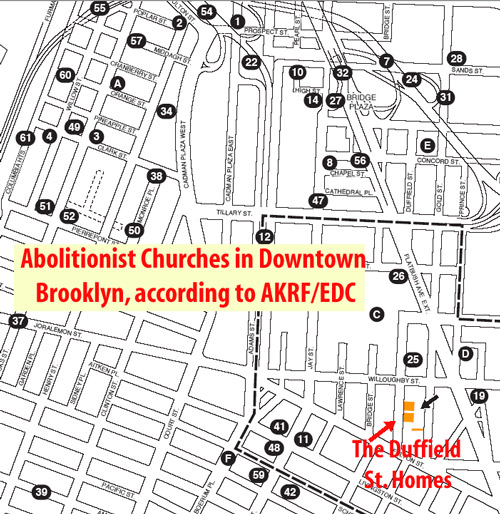
The buildings believed to be Underground Railroad sites on Duffield Street in downtown Brooklyn had their day before the City Council on Tuesday in what turned out to be a marathon hearing that ran from 11AM-3PM. At issue is whether the city will demolish them in order to build an underground parking garage that will serve several developments, including hotels that are rising across the street. A $500,000 consultant’s study that weighs in at 700 pages that was commissioned by the city says there is no hard evidence that the buildings were part of the Underground Railroad. (Someone from the AKRF firm that did the study said the firm devoted 3,000 person hours to the report, which works out to $166.67 an hour.)
We couldn’t attend, but there are at least two reports that convey the substance of the meeting, which included a lot of serious questions from council members, most notably Letitia James. The Historic Districts Council Blog offers this description:
CM Letitia James was methodically going over all her issues with the 700-page report, item by item. To call this unusual would be an understatement. It was great – she questioned specific issues and concerns that had been brought up with alacrity. Even more surprising was that Council members Liu and Yassky also took their turn at bat. CM Liu hounded the reps from EDC on whether or not the Downtown Brooklyn Plan could go forward without this piece (the answer, finally, was “yes” but this part of the Downtown Brooklyn Plan – the parking lot and the “open space” for commercial tenants couldn’t) and CM Yassky was strong on taking a hard look at these historic structures.
In addition, the Underground Railroad Safehouses site offers a very detailed look at the hearing and at the consultant’s report that is now at the heart of the controversy. Even the consultant’s report, which argues for demolition–which is what the Economic Development Corp. which paid the firm the $166 an hour–admits that “more information could be unearthed in the future” showing a definitive link between the Underground Railroad and the Duffield Street houses.
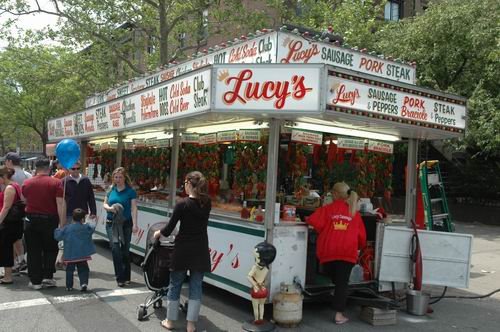
Running low on tube socks? Be not afraid, for Street Fair Season cometh. The first South Brooklyn expression of the phenomenon is the Court Street Fair, which happens this Sunday (5/6). It’s actually one of the ones we like, along with the Fifth Avenue Fair, possibly because they come early in the season. By the time June rolls around, our instinctive reaction is more along the lines of, “Crap, another street fair.” This is not because we dislike street fairs in principle, but because as has been documented, they are all virtually controlled and programmed by the same company, drawing the same groups of vendors.
Inject some neighborhood flavor into these things by loosening the vice-like grip of the company that produces most of them, Mardi Gras Productions, and they would morph from annoyance to something fun. A couple of years ago, WNYC’s Brian Lehrer provoked some discussion of the generic nature of street fairs in a NY Times op-ed in which he called the fairs “another cog in the economy, posing as part of the neighborhood.” Our favorite analysis comes from the Center for an Urban Future, which concludedthat street fairs are generic and bland.
In the meantime, now that we’re done with the burst of negativity, here’s a very selective list of some of the notable ones, courtesy of the Community Board 6 calendar and a couple of other sources:
May 6—Court Street Fair, Sponsored by the Gowanus Canal Community Development Corporation (GCCDC) on Court Street between President and West 9th Streets. 10AM-6PM
May 20—Fifth Avenue Fair. Fifth Avenue between Flatbush Avenue and 14th Street.
June 9—Brooklyn Pride Street Fair. Prospect Park West between 9th and 15th Streets.
June 17—Seventh Avenue “Seventh Heaven” Street Fair. 7th Avenue between Flatbush Avenue and 15th Street.
June 24—Smith Street Fair. Presented by the South Brooklyn Local Development Corporation on Smith Street between Bergen and Union Streets.
September 30–The 33rd Annual Atlantic Antic on Atlantic Avenue.
This year’s tour gets underway at Grand Army Plaza, a National Historic Landmark at Prospect Park. This year’s 18 mile tour will feature Brooklyn’s southern neighborhoods along the waterfront like Sunset, Bay Ridge, Dyker Heights and Bensonhurst and loops towards the heart of Brooklyn, Kensington and Prospect Park South to end at the Carousel.
If this is your first time to Brooklyn by bike don’t worry you can join our feeder ride, leaving from Cadman Plaza near Brooklyn Bridge. Ride will depart promptly at 7:45 am, arriving at Prospect Park 8:05 am.
Ah, spring.
Comments Off on Strap Up for the Third Annual Tour de BrooklynTags:Transportation
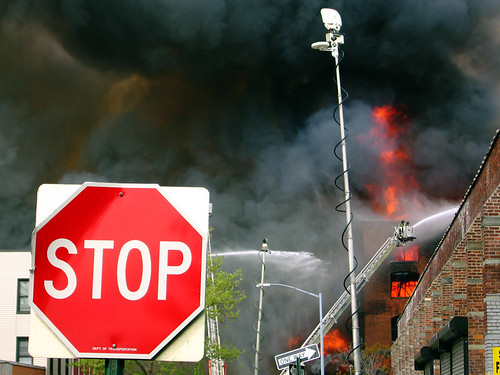
A year ago today, the Greenpoint Terminal Market went up in a huge blaze that almost took part of Greenpoint with it. We remember looking up that morning and seeing a gigantic black column of smoke rising in the distance and wondering what the heck could be burning. Then, we heard it was a “warehouse fire” in Greenpoint and we knew what it was before even finding out for sure it was the Greenpoint Terminal Market. A local homeless man, Leszek Kuczera, was implicated in starting the fire while trying to steal copper wire. Coincidentally, the fire happened as landmarking moves were underway. Jotham Sederstrom offers a summary of the GTM fire aftermath one year later in today’s Daily News. A sample:
A year after the city’s largest inferno in a decade engulfed 15 buildings along the Brooklyn waterfront, the historic site of the Greenpoint Terminal Market remains a charred wasteland and a sore spot for locals.
Nobody has been convicted in the arson fire that broke out on May 2, 2006, and eventually took 6 million gallons of water to extinguish. And nothing has been developed on the scorched earth where the warehouses once stood.
“That fire destroyed one of the most beautiful industrial buildings on the waterfront. and that’s a permanent loss,” Councilman David Yassky, who represents the area, said yesterday. “There’s nothing good about it.”
Some 400 firefighters battled the 10-alarm fire, which burned for 11 hours on a sunny day near Noble St. in Greenpoint. When it was finally extinguished two days later, six square blocks were destroyed. Preservationists had wanted the site to be landmarked.
Plans for the property, which was slated for a huge highrise complex, are pending. For those that are interested, we have a set of the GTM fire aftermath here and of the pre-fire complex here. Also a before and after YouTube video here.
May 2nd, 2007 · Comments Off on Greenpoint Terminal Market Photos
There are 1,215 photos on flickr tagged “greenpoint terminal market.” There are 1,701 photos that are tagged “greenpoint fire.” In addition, you can find cool post-fire exploration photo sets from e-liz and f.trainer.
Comments Off on Greenpoint Terminal Market PhotosTags:Greenpoint
This is a little celebration we came across at Our Lady of Mt. Carmel Church on Havemeyer Street in Williamsburg, which also hosts the big Giglio Festival in July. Note the money taped to the saint.
Comments Off on A Taste of the Old WilliamsburgTags:Williamsburg
What you’re looking at is 66 N. 1st Street, which is between Kent and Wythe, just across the street from the site of the former Old Dutch Mustard building and the future 80 Met. This was the scene as the Thing on Top, which is another product of Scarano Architects–whose principal, Robert Scarano, is clearly the King of the Thing on Top–starting with the building his firm occupies in Dumbo, whose Thing on Top puzzles passing motorists on the BQE and the Manhattan Bridge with its changing colors–was being worked on. Brownstoner had some information on the project back in November, when the building had been gutted. The final product will have 20 condos.
The good news here is that the Gowanus Yacht Club on Smith Street is open again for the season. One of our readers, though, writes to take some issue with the limited menu (hot dogs) and wonders about bringing in some food to go with the brewskis. He writes:
My girlfriend and I took at moment to indulge at the Gowanus Yacht Club this Saturday while waiting for the laundry to dry. Couple of thoughts…
– We asked if we could bring a falafel in (who doesn’t love Zaytoons!?) to eat with the beer we were purchasing. We were told we couldn’t and that we would have to order something the club was selling. A quick look at the menu reveals hot dogs and… hot dogs. Nothing really for the vegetarian (and nothing really for anyone who, um, thinks hot dogs are kind of gross). We were forced to drink our beer in hunger!
In all seriousness, why not let us bring our food in if all you’re going to offer is hot dogs? We quickly learned rule #2 — don’t ask. Some others just brought food in and were left alone. Go figure. They did, however, get some stares from the staff..
– The owner(?) and his two bartenders were a little intense. They kept eyeing everyone and walking over to ask if they wanted another. And it wasn’t that “hey, want another?” friendly service that would be appreciated. It was more the, “hey, drink more so I can charge your for another.”
Hmm… Maybe I still have a little winter bitterness in me, but, come on GYC!
We’re certain there are varying opinions on bringing outside food into an establishment, but it gets more interesting, because as our friends at Eater note, the GYC has lost its grill and only seems to be serving boiled hot dogs. Specifically:
When Eater operatives rolled in Saturday night, however, they were met with a cruel surprise—the outdoor grill that has served up burgers, sausage, and grilled hotdogs has been deep-sixed, replaced with a simple wooden counter… Apparently, neighbors on the street, vexed by noise and odors, discovered the grill was illegally installed and successfully petitioned to have it removed during the offseason. The venue had no choice but to cooperate. For now, as the season dawns, the GYC is serving up (boiled) hot dogs only—a fine treat, to be sure, but not the menu of yore we’d come to expect.
Small upsides: a fancier beer list this season, and an ever-so-slightly upgraded bathroom area. Still, once news of GrillGate spreads, can street protests from angry GYC patrons be far behind?
Seems to us that GrillGate backlash is already underway.
We featured some night shots of this building at N. 10th and Berry, courtesy of our Greenpoint correspondent last week, and had a look ourselves in daylight this weekend. It does not disappoint. The sidewalk has been undermined, the fence is now out in the street and could take your eye out if you’re not careful and the building next door is doing crack. Don’t take our word for it, though, even the Department of Buildings has noticed. Quoth the inspectors in writing out a Partial Stop Work Order that only seems to allow work to prevent a collapse of the sidewalk or neighboring buildings:
There is no shoring of the adjacent foundation, the sidewalk has completely collapsed, there are cracks in the foundation wall at 130 N. 10th.
In other words, just another day in North Brooklyn. It’s supposed to be a four-story building with four units.
Every time we pass through Wallabout, the neighborhood down by the Brooklyn Navy Yard, we wonder when developers are going to start renovating some of the old buildings or putting up new ones. Last week, of course, the city announced a new mostly affordable housing development on the old Navy Brig site. The new Real Deal has an interesting article by Gabby Warshawer about Wallabout that suggest that it could be the next Dumbo. It even quotes Jed Walentas drawing some parallels between the two neighborhoods. Ms. Warshawer writes:
…the district near Brooklyn’s Navy Yard is poised to steal some of the luster of its well-heeled neighbor to the west.
Wallabout — which encompasses a mile-long stretch north of Fort Greene and Clinton Hill between Flushing and Park avenues near the Navy Yard — is the borough’s latest enclave set to undergo a gritty-to-glam story of urban revival. Several small- to medium-sized trendy retailers have set up shop in the neighborhood within the past few years, bringing increased foot traffic to a stretch of blocks still dominated by warehouses.
The story covers a lot of ground and is absolutely worth a read.
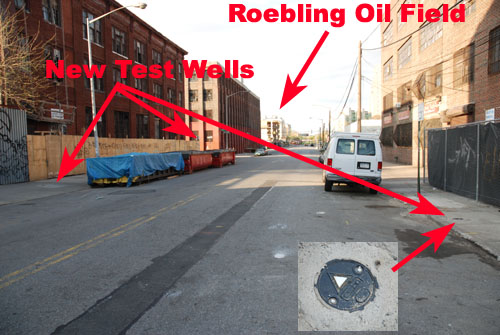
Don’t look now, but Roebling Street in Williamsburg has more oil wells. Actually, they are monitoring wells. Several were recently drilled around the Roebling Oil Field months after oil began oozing onto the site of the McCarren Park Mews condo development. Several more have now been placed on N. 10th and N. 9th Streets and on Roebling Street between N. 8th and N. 9th. The drilling took place last week according to a neighborhood resident. While the test wells don’t mean that oil is underfoot, they do mean that there is some interest in whether the oil at N. 11th Street and Roebling is only in that area or whether it is more widespread. One of the test well is in front of a development at N. 8th and Roebling on the site of the old Tribeca Oven. Others are around an old industrial building at N. 9th and Roebling that is being renovated as a condo development.
Williamsburg activist Phil DePaolo, who has been contacting local officials to investigate the underground oil and its source and is pushing for stepped-up Department of Environmental Conservation monitoring of developments and cleanups, told GL that no reports have been given as yet to City Council Members or to state legislators about any findings about the Roebling Oil Field problem or the source of the oil pollution.
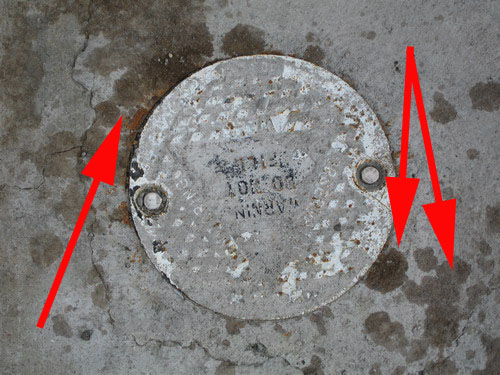
The photo below shows one of the test wells in the sidewalk adjacent to the Roebling Oil Field building and what appear to be oil stains around it.
We missed the Lola Staar party in Coney Island on Sunday because we were busy in Williamsburg and we couldn’t be two places at one time. Bad, bad, bad, bad, bad decision. As it turns out, developer Joe Sitt decided to make an appearance at the Staar party, which took place at Ruby’s on the boardwalk. The Village Voice’s Neil deMause filed this report on the Voice blog Runnin’ Scared:
…the Coney old guard gathered at Ruby’s venerable (and venerated) boardwalk restaurant for a celebration: Dianna Carlin’s Lola Staar Boutique, given up for dead after Sitt refused to extend her lease after a squabble over that same gag order, had reopened, once again making the boardwalk safe for Cyclone baby tees and mermaid floaty pens. Sitt, explains Carlin, had called her the day before the “Save Coney Island” rally she organized at City Hall last month, and after an hour-long phone chat, ultimately agreed to extend her stay through October for “very little money”; Carlin didn’t sign a confidentiality clause, she stresses, and plans to continue to speak out against Thor’s condo plans.
The party featured a hot pink cake and the guitar stylings of Polar Bear Club troubadour Amos Wengler (his “Lola Staar Is Back,” with its singalong chorus of “Don’t mess with Lola/She’s gonna react,” was a particular hit). But all were upstaged when in walked Joe Sitt himself, dressed in shades and a polo shirt. As onlookers goggled, the developer grabbed a plate of sausage and onions, and greeted his erstwhile adversary Carlin like an old friend.
While Sitt wouldn’t comment on the record—he spent much of his time at Ruby’s ducking the videographers who dogged his every step—his Thor associate Digna Rodriguez-Poulton hinted that the fenced-in tire-strewn wasteland that currently occupies much of Thor’s Coney holdings wouldn’t remain that way all summer, with a circus a possibility in July or August.
Given the remarks passed around at the Ruby’s bar, Sitt still has a long way to go to win over a skeptical Coney populace. (“You’re Joe Sitt?” one patron gasped on meeting him. “You don’t have horns!”) Even Carlin, who once again seems hopeful about the future, with a sitdown scheduled with Sitt for next week to discuss his plans, isn’t deluding herself that all is now copacetic: “It’s all about bargaining tactics, and if that doesn’t work, he could be back to evicting us all in a few months.”
A much rescheduled City Council hearing on the Underground Railroad Houses on Duffield Street takes place today at 11AM. It will be preceded by a 10AM press conference that will include Charles Barron and David Yassky. The city wants to tear down because they’re on the site of a proposed parking garage. A controversial consultant’s study downplayed the historic significance of the houses. You can watch the YouTube vid by clicking here if there is a problem with the embed. The vid details the issue and the consultant’s handling of the study. The creators of the video sent an email press release saying:
The story rightfully should anger you, because this report distorts history. The Duffield St. residents and friends of Brooklyn history are taking their case to the people via you tube. This short film is being submitted as testimony at the May 1st hearing as well.
Expect some pointed remarks at both the press conference and the hearing.
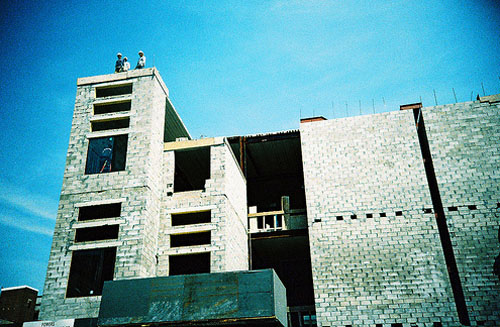
If this photo doesn’t convey the essence of the building at Carroll Street and Bond Street that we call The Bunker, we’re not sure what will. This shot of workers atop The Bunker was posted on flickr and brought our attention by the photographer, Michael Kuhle, who’s a GL reader. Nice, huh? Also, we noted this weekend that glass is going into the little bunker windows. That should be a fast process as, well, there just aren’t that many of them.
May 1st, 2007 · Comments Off on Room 58: Writer’s Space at BAG in Gowanus
The Brooklyn Artist’s Gym in Gowanus is opening a shared space for writers called Room 58. Here is some information from the email we got about it yesterday:
In a corner of Brooklyn Artists Gym’s shared studio space for visual artists is Room 58, a new workspace designed specifically for journalists and other research-based writers. Behind the door marked 58 are actually two rooms, an outer office area with desks, fax, printer, research materials and file storage, and an inner quiet room with eight individual cubicles and a couple of nice views of Manhattan.
“For some of our writers, telephone work is essential to what they do,” says Scott Adkins, co-founder of Park Slope’s popular Brooklyn Writers Space (BWS) and partner in the new Room 58/BAG venture. “BWS is a great quiet environment for writers of all genres. But for those writers who also need traditional office capabilities, Room 58 is ideal.”
Down the Slope on the third floor of 168 7th Street, BAG is a hub of creative enterprise. In addition to a large, well-lit studio with room for visual artists to work at any given time, BAG offers a newly renovated gallery space, open figure drawing sessions and a variety of workshops on subjects from beginning bookbinding to accordion folds. The creative energy at BAG is palpable, with exciting possibilities for cross-pollination between artists and writers.
The fee for Room 58 is $375 per quarter, plus a one-time $65 initiation fee. More information here. Writing space in Gowanus, people!
Comments Off on Room 58: Writer’s Space at BAG in GowanusTags:Gowanus
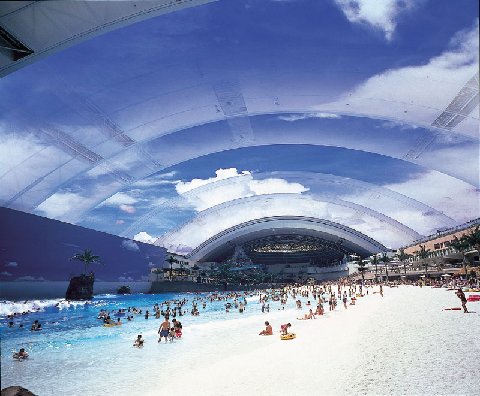
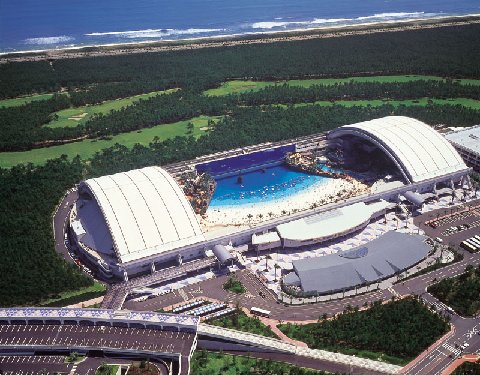
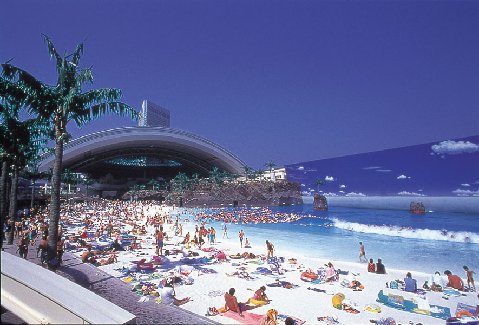
So, here’s the “year-round” Coney Island solution, though it does look like it takes up a lot of real estate. It comes from Japan, from whence a lot of interesting land use, planning and architectural ideas originate. (Dubai is an excellent source as well.) This came to our attention in the context of someone circulating it as a joke vis a vis McCarren Pool, but we know a unique Coney Island concept when we see one. It’s part of the Phoenix SeaGaia Resort in Miyazaki.
Perched upon a towel, stretched out on an immaculate white beach, I have turquoise sea in front of me and a cloudless sky overhead. Not a bee, sand fly or mosquito can be seen. The weather is perfect. It’s warm enough for swimming in the inviting sea, but there is no danger of sunburn. A cold drink lays close at hand, along with a thick, juicy novel.
Suddenly, a strange haze drifts into view. Smoke envelops the top of a nearby mountain, which begins spitting out sparks of fire. Eruptions can be most annoying, but not here, not in paradise. As the volcano stirs to life, I don’t even bother. Checking my watch, I see it’s only the half-hour eruption. Returning to my book, I savor a smile. There is still another 30 minutes before the mountain blows its top.
Paradise proceeds with clockwork precision inside Ocean Dome, Japan’s unique, sometimes surrealistic, but utterly updated version of the Garden of Eden. Inside a huge dome that could house six football pitches, the world’s largest artificial sea washes over the biggest indoor beach, fringed with fake palm trees and other eye-popping innovations that have given a holiday make-over to old Mother Nature.
This evocative 21st Century resort shows that even paradise has room for improvement. In Ocean Dome, once every hour, on the hour, the surf is always up. Every afternoon is a carnival. Mechanized parrots squawk from branches of the dome’s ingenious rain forest, which remain lush and tropical without rainfall or humidity. Best of all, in Ocean Dome, you can lull for hours on crushed marble pebbles without a worry about beach vendors, bugs or sun burns.
Instead, perfectly-timed waves whip equally well-groomed surfers along in 28-degree, chlorinated, salt-free water to the sanitized shore where they drip-dry in Ocean Dome’s perfect climate, which remains a delightful 30 degrees, day and night, 365.25 days each year.
Note to Thor Equities: This one’s a winner. It could be the Bellaggio of Water Parks.